


SAINT DOMNIUS CATHEDRAL is the oldest cathedral in the world. It is a combination of various styles such as Gothic, Baroque and Romanesque. The entrance wooden door is the best example of the medieval style constructed by a local maestro Andrija Buvina. The door has 28 scenes from Jesus`s life carved in nutwood. Saint Domnius (Duje) to whom the cathedral is dedicated to is withal the patron of our city, and in his honor we celebrate the day of the city each year (May 7th).
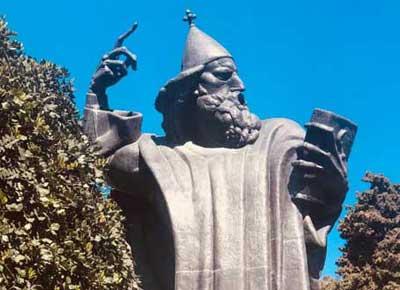
Statue of Grgur Ninski
STATUE OF GRGUR NINSKI (GREGORY OF NIN) is one of the most important symbols of the city. It is situated on the northern part of the Palace, in front of the Golden gate. The statue is over six meters high made by our most famous sculptor Ivan Meštrović. The Nin bishop was important to Croatians mostly because he was a main protagonist of the old slavic language and glagolitic script. For those who believe in the legend that if you touch his toe on the statue and make a wish he is a symbol of happiness and joy.
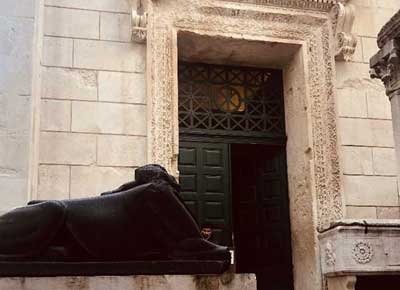
Temple of Jupiter
The temple of Jupiter or Baptistery of John the Baptist is one of the original buildings inside the Roman Palace built by the emperor Diocletian between the 3rd and the 4th century AD. The emperor was infatuated with eastern beliefs, and he proclaimed himself the living son of Jupiter so he built a temple for his ''father'' inside his palace. Originally there were two other temples standing in front of the temple of Jupiter, one dedicated to Venus and the other dedicated to Cybelle, two goddesses that the emperor worshiped as well.
Our dear tourists, you should definitely visit the temple of Jupiter during your vacations in Split, at least from the outside where you can see a headless sphinx standing in front of the entrance and the entrance itself which is nicely decorated with original roman decorations influenced by eastern antique decorations. Next to the temple you can find the tightest ally in the world, the so called 'Let me pass trough' ally. You should definitely pass trough it!
For a small fee you can enter the temple. After Diocletian, it became a christian religious baptistery so inside you will see the stone baptistery inscripted with images of Croatian kings and other symbols representing Croatian historical symbols and religious motives. There is also a piece of artwork of Ivan Meštrović, our great worldwide known sculptor, a wooden sculpture of John the Baptist to whom the baptistery/ex temple is dedicated to.
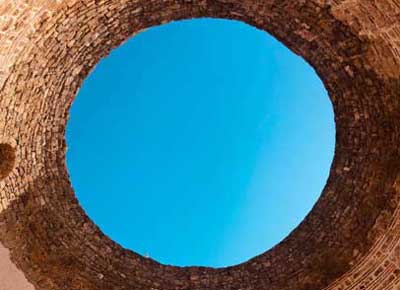
Vestibul
VESTIBUL is the first part of the imperial corridor that led from Peristil through the protir to Dioclecian`s residential part of the Palace. The main characteristic is its circular interior and a big opening through which the bell tower of Saint Domnius can be seen. The opening used to have a dome which was in white stone decorated with a glittering coloured mosaic and semicircular niches filled with statues. Today, during summer time it is used as a popular place for singing traditional Croatian accapela music (klapa).
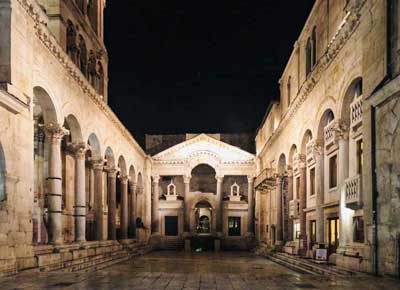
Peristil
PERISTIL is the central square of Diocletians Palace, the intersection of two main streets Cardo and Decumanus, which was a tipical way of building cities in the Roman architecture. It is surrounded by two lines of columns which were decorated with sphinxes on each side. Today you can still see three of them, one is located in the city museum, the second in front of Jupiter´s temple and the third still standing on the square. White stone from island Brac was mostly used in the building of our most famous square. During summer Peristil is the host of Summer festival in which you can enjoy Croatian tradicional music as well as classical Operas.


